

For six months after joining Quest Global, Abril lived with a contradiction.
Outside of work, she was already embracing her identity as a woman. At work, without official documentation reflecting her name, she continued introducing herself using her former name and presenting herself in a way that no longer felt authentic.
What followed was a daily balancing act between two realities: one personal and one professional. When the time finally came to tell her manager and colleagues that she was trans, the experience became one of the most liberating moments of her life.
In this conversation, Abril reflects on her gender transition journey and the small acts of support that can make all the difference.
You joined Quest Global in the middle of your transition. What was that like?
When I started working here, I didn’t have my updated national ID yet, so I introduced myself using my former name. It was a professional environment, and I didn’t want to draw attention to myself. I preferred to wait until I had my official ID and some formal proof of my identity.
For six months, no one at work knew you as Abril. What impact did that have on you?
Yes, it was difficult. I had to make a conscious effort in how I spoke about myself, because in my personal life, I was already living as a woman. I had to carefully choose every word that referred to me. I switched mindsets when entering and leaving work, and I generally avoided talking about myself altogether.
What finally gave you the confidence to share that part of yourself at work?
I spoke with my manager, Pedro, on a Friday. He’s very calm and approachable, so the conversation felt easy from the start. He immediately contacted Human Resources to update my name in the company systems and suggested that I personally share the news with my colleagues the following Monday.
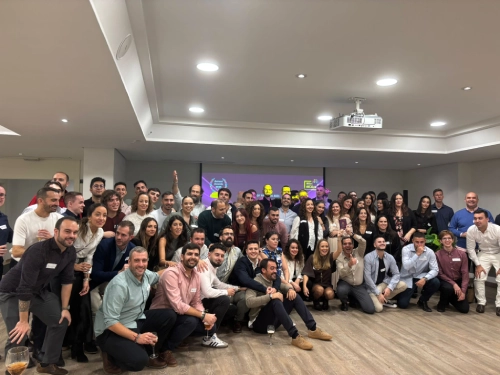
That’s exactly what I did. I spoke with them one by one, and everything went really well. They showed interest in my experience and asked questions out of genuine curiosity and respect. Occasionally, out of habit, some people called me by my former name, but anyone in the community understands there’s usually an adjustment period when someone changes their name. I never took it personally. Today, I am fully Abril, to myself and to everyone else.
Looking back now, what stands out as the biggest challenge?
I’m currently undergoing hormone therapy, which comes with its own adjustments, but overall I’ve been fortunate to navigate my transition with the support of a strong network of family, friends and colleagues. The biggest challenges I’ve faced have often been practical rather than personal. For example, some of my academic qualifications still don’t reflect my current name, and many administrative systems aren’t designed to accommodate experiences like mine.
Having a supportive environment has made a huge difference, allowing me to focus on moving forward while tackling those obstacles one step at a time.
Knowing what you know now, would you have done anything differently?
That’s a good question. After seeing my colleagues’ reaction, I honestly don’t think anything bad would have happened. But at the time, I preferred to protect myself and wait until I had official documentation that reflected my identity.
I’d only recently joined the company. I felt I first needed to prove my professional value, get to know people and let them get to know me as a person. Only then did I feel comfortable sharing that part of myself.
Quest Global has felt like a safe place for you. What helped create that sense of trust and belonging?
Quest Global has always felt like a safe place, but it’s still a professional environment where certain conversations can be difficult, whatever the subject.
I think trust is built through everyday interactions. When you can have all kinds of conversations with your colleagues without feeling judged. When they take an interest in you and ask how you’re doing. When you see diversity represented throughout the workforce. When support is shown openly and explicitly.
I remember that during Pride Month last year, you distributed cards with supportive messages and bracelets in the offices. I still have that card pinned above my desk. For me, it was an important message. It made me feel I was in the right place.
What do you hope people take away from your story?
I’m here today because you’ve given me a platform simply for being myself. Whenever I say this, people in my circle tell me otherwise, but I haven’t done anything extraordinary. I’ve simply existed as who I am. And it’s precisely because I am myself that I’m here speaking to you today.
That shows that, although society is more tolerant and accepting than it used to be, there’s still a long way to go. If we’d truly reached the point where everyone was fully accepted, a story like mine would no longer be necessary. And when that day comes, we’ll be able to say we’ve truly overcome these challenges.