


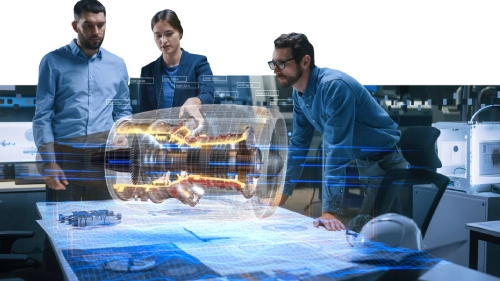
Aerospace & Defense (A&D) manufacturers are under increasing pressure to accelerate innovation, improve operational efficiency, maintain regulatory compliance, and meet ambitious sustainability goals, all while managing some of the industry’s most complex products and supply chains. In this environment, data has become a strategic asset. Digital Thread and Digital Twin technologies are helping organizations connect engineering, manufacturing, and operational data across the product lifecycle, enabling faster decisions, improved quality, and greater operational visibility.
To fully realize these benefits, organizations must understand how Digital Thread and Digital Twin technologies complement each other.
The Digital Thread is the data network that connects all systems from design and development through manufacturing, delivery, and field support. It enables product and process information to move across departments and systems in real time.
The Digital Twin is a virtual representation of a specific physical product, process, or system performance. It is used to simulate real-world scenarios, enabling engineers to analyze behavior, optimize performance, and identify potential issues before or after physical production.
How They Work Together
A Digital Twin is limited to a specific product or process and does not scale across an entire enterprise on its own. The Digital Thread provides a broader framework that connects departments, teams, and business systems across the product lifecycle.
Digital Twins rely on data flowing through the Digital Thread to run simulations and performance models, such as those that predict failures or maintenance requirements. As a result, the Digital Twin functions as a specialized capability operating within the broader Digital Thread ecosystem.
Understanding the relationship between these technologies is only the first step. Their real value emerges when they are applied to critical Aerospace & Defense challenges.
1. Balancing Safety and Innovation in New Product Introduction
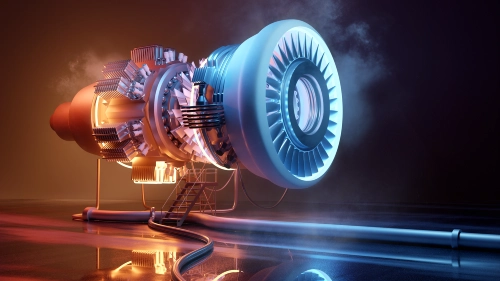
Meeting production demands without compromising safety requires manufacturers to identify potential issues as early as possible. Together, Digital Thread and Digital Twin technologies enable teams to uncover problems during the design phase, helping maintain production schedules while improving product reliability.
- Design-stage simulation: Digital Twins simulate operational stresses, allowing engineers to identify and address potential mechanical failures before physical manufacturing begins.
- Manufacturing scale: As programs move from design to full-scale production, Digital Twins connect to the Digital Thread to collect real-time data from shop-floor IoT and IIoT sensors. This data helps manufacturers balance supply and demand, resolve factory bottlenecks, improve quality control, and accelerate delivery timelines.
2. Managing Regulatory Compliance with Data Traceability

The Aerospace & Defense industry operates under strict regulations from organizations such as EASA and the FAA to maintain public confidence in passenger safety and product reliability. Compliance requires organizations to create, manage, and maintain extensive product documentation, often involving significant investments in software systems, skilled resources, and complex verification processes.
The Digital Thread simplifies compliance through three key capabilities:
- Automated data management: The Digital Thread automatically captures product records across multiple software systems, reducing manual data entry and minimizing human error.
- Complete audit trails: The Digital Thread provides a clear view of data history, giving inspectors and auditors complete traceability whenever required.
- Engineering change tracking: When design updates occur, changes are automatically reflected across manufacturing and service workflows. This ensures production remains aligned with approved quality standards while accelerating compliance reviews.
3. Operational Performance and Project Metrics

Beyond improving visibility and collaboration, Digital Thread and Digital Twin technologies can deliver measurable business outcomes across manufacturing, quality, and operational performance.
By creating a single source of truth, organizations reduce misinterpretation, improve collaboration, and enable earlier design validation. The result is less rework, fewer production errors, and higher customer satisfaction.
Quest Global has helped customers achieve the following outcomes:
- 44% Better production efficiency: Achieved by implementing digital manufacturing models instead of traditional production line setups.
- 95% Right-First-Time quality rate: Improved from a baseline of 67% for a specialized forging client, significantly reducing material scrap.
- Zero-downtime operations: Delivered for an automotive company through automated predictive maintenance scheduling.
- Improved quality capability index (From 0.67 to 3.0): Achieved through machine learning-based predictive failure models developed for aerospace components, creating a foundation for zero-defect manufacturing.
- $1M Saved annually: Delivered for a Tier-2 supplier by using data analysis templates to identify weld and adhesive defects, reducing scrap rates by 5%.
While the benefits are significant, realizing them at scale requires organizations to overcome several technology and workforce challenges.
4. Resolving Software and Workforce Challenges
A&D organizations face several barriers when implementing digital technologies, which is one reason adoption has historically been slower than in industries such as automotive.
- The software interoperability problem: A&D organizations often use numerous specialized software platforms, each providing unique operational advantages. Connecting these systems requires open application programming interfaces (APIs), such as Catia-to-NX data translators, as well as data migrations between Product Data Management (PDM) and Product Lifecycle Management (PLM) systems. Emerging frameworks such as GAIA-X are also helping establish standards for secure and transparent data sharing across organizations.
- Workforce transitions: A shortage of specialized technical talent, an aging workforce, and supply chain partners that are hesitant to adopt new technologies can slow progress. Overcoming these challenges requires strong leadership, effective change management, and a culture that embraces transformation.
- The implementation roadmap: A structured implementation plan is critical. Quest Global works with technology partners to assess existing digital environments, identify capability gaps, select appropriate technology solutions, and validate concepts through pilot programs. Once proven, these solutions can be scaled across global operations and supply chains to maximize return on investment.
Once digital foundations are established, organizations can begin leveraging connected data not only for operational performance but also for sustainability outcomes.
5. Lowering Environmental Impact Through Better Efficiency
While studies suggest the Aerospace & Defense sector contributes less to global carbon emissions than industries such as construction, electronics, and ground transportation, manufacturers remain focused on reducing greenhouse gas emissions by 30% to 40% over the next decade.
Because Digital Threads and Digital Twins improve operational efficiency, they can directly support reductions across Scope 1, 2, and 3 emissions by minimizing waste, inefficiencies, and unnecessary resource consumption.
- Less component scrap: Virtual testing helps ensure components are manufactured correctly the first time, reducing material waste and preventing scrap from reaching landfills.
- Lower energy use: Predictive maintenance systems for aircraft engines and manufacturing equipment provide visibility into asset performance, allowing teams to address issues quickly and improve energy efficiency.
- Supply chain coordination: Connecting suppliers to a manufacturer’s Digital Thread provides real-time visibility into inventory, logistics, and packaging decisions. This supports Just-In-Time (JIT) manufacturing and helps align production more closely with actual demand.
- The paperless factory: Reducing paper-based processes on the shop floor lowers environmental impact while improving operational efficiency. Quest Global is currently demonstrating this approach by helping its sister manufacturing organization in India transition toward a paperless operating model.
6. The Next Five Years in Aerospace Technology
As adoption matures, Digital Thread and Digital Twin technologies are expected to evolve beyond visibility and optimization to enable increasingly autonomous and interconnected aerospace ecosystems.
Three key trends are expected to shape the future:
- Autonomous models: Digital Twins will increasingly incorporate machine learning to make autonomous decisions about inventory levels, maintenance requirements, and supply chain disruptions.
- Multi-domain systems: Defense operations will focus on connecting virtual models of ships, aircraft, satellites, and ground assets into a unified operational view.
- Automated supply chain emissions tracking: Carbon tracking across complex supply chains will become standard practice, helping organizations meet sustainability goals while supporting the transition to sustainable aviation fuels (SAF) and hydrogen-based logistics.
Digital transformation is becoming a competitive necessity. Digital Thread and Digital Twin technologies are no longer emerging concepts. They are becoming foundational capabilities for Aerospace & Defense organizations seeking to improve quality, accelerate innovation, strengthen compliance, and build more resilient operations.
As these technologies continue to evolve, organizations that successfully connect engineering, manufacturing, and operational data will be better positioned to compete in an increasingly complex and data-driven industry.
7. How Quest Global Can Help You Get There
Successfully integrating Digital Thread and Digital Twin technologies requires deep engineering expertise, domain knowledge, and a structured approach to execution. Quest Global acts as an execution partner, helping Aerospace & Defense organizations transform digital concepts into scalable operational outcomes.
We support this journey through three core capabilities:
- Solving software interoperability: We help eliminate data silos by building open APIs, managing complex PDM-to-PLM-to-MES data migrations, and enabling secure data sharing across edge and cloud environments aligned with frameworks such as GAIA-X.
- Executing the implementation roadmap: We evaluate existing digital environments, identify capability gaps, execute low-risk pilot programs, and scale proven solutions across global operations and supply chains using Quest Global’s proprietary frameworks.
- Delivering proven business outcomes: Our approach is backed by measurable results, including a 44% improvement in production efficiency, a 95% right-first-time quality rate, and annual savings of $1M through scrap reduction initiatives.
As the industry advances toward autonomous systems, multi-domain operations, and automated emissions tracking, Quest Global provides the engineering expertise, technical talent, and ecosystem partnerships required to accelerate digital transformation safely, efficiently, and at scale.