


Synopsis:
Corporate sustainability programs have invested heavily in measuring and reporting Scope 3 emissions, yet the numbers keep moving in the wrong direction. Measuring emissions more precisely does not change the decisions that created them. For engineering-intensive industries, those decisions live in engineering, years before a sustainability report is written. This article examines how to move from reporting to redesign.
Corporate sustainability programs have invested heavily in measurement and reporting over the past several years, including investments in carbon accounting platforms, supplier surveys, disclosure frameworks, and third-party validations. The infrastructure for tracking emissions has matured considerably, moving from approximations to estimations to measurements. Yet for most product companies in aerospace, automotive, energy, and industrial sectors, the numbers keep moving in the wrong direction.
Microsoft, widely regarded as a sustainability leader, offers a helpful illustration of this structural challenge. The company set ambitious goals in 2020 to become carbon negative by 2030. Four years later, their total emissions across Scopes 1, 2, and 3 had increased by 29.1% from that baseline, driven largely by data center expansion for AI workloads.1 Their direct operational emissions (Scopes 1 and 2) actually decreased by 6.3% over the same period. The gap between those two figures reveals where the real problem lies.
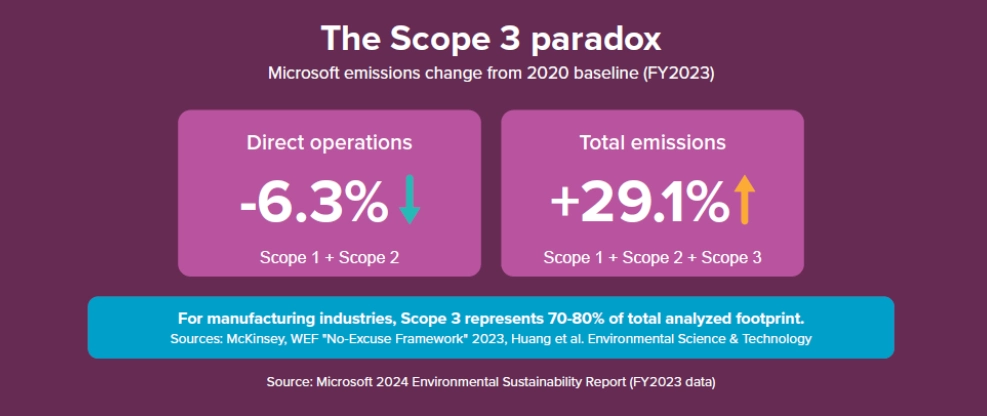
McKinsey estimates that Scope 3 emissions typically account for around 90% of a company’s total carbon footprint, though this varies by industry.2 For manufacturing sectors specifically, research indicates that Scope 3 represents 70% to 80% of the total analyzed footprint.3 These are the emissions embedded in purchased materials, generated during product use, and created at the end of life. They sit outside the factory fence but inside the product specification.
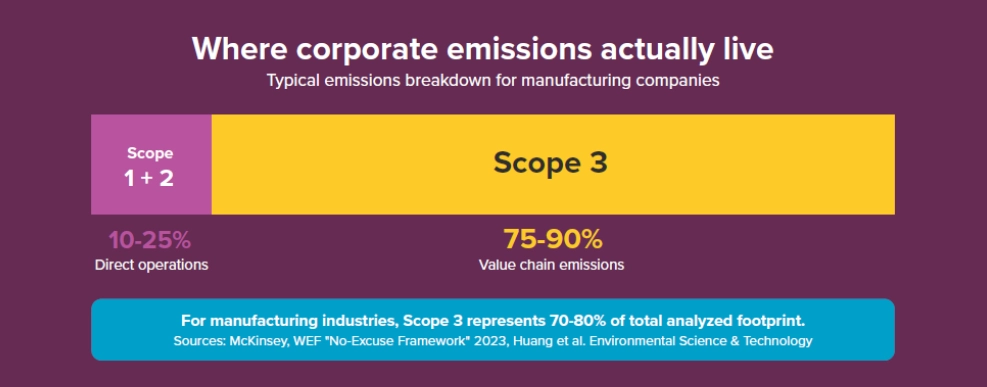
Most sustainability strategies treat Scope 3 as a measurement and reporting challenge. Teams invest in carbon accounting software, conduct supplier surveys, and build disclosure capabilities to satisfy CSRD, ESRS, or SBTi requirements. These activities are necessary but may not be sufficient. The fundamental problem is that Scope 3 emissions are determined by engineering decisions that get locked in early in product development and persist for the entire service life of the asset. Measuring those emissions more precisely does not change the decisions that created them.
Engineering decisions in disguise
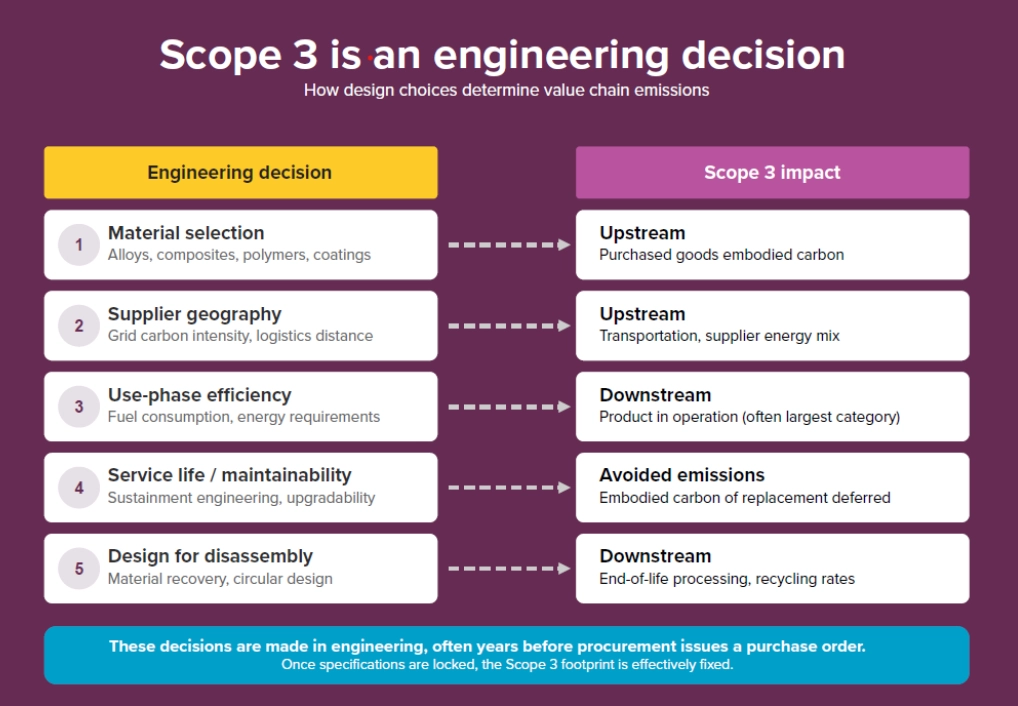
Consider how Scope 3 actually accumulates for a product company. Upstream emissions come from the materials and components engineers specify. Engineering teams choose between aluminum and carbon fiber composites, between a casting and an additive-manufactured part, between a supplier in a coal-dependent grid versus one running on renewables, often years before procurement ever issues a purchase order. Once the material is specified and the supplier qualified, the upstream Scope 3 footprint is effectively fixed.
Downstream emissions follow a similar pattern. The energy efficiency of a product in operation, its expected service life, its maintainability, and its end-of-life recyclability are all determined by engineering choices made during development. An aircraft engine that burns 15% less fuel per flight hour will generate 15% fewer downstream Scope 3 emissions across a 30-year service life. That outcome was decided in the turbine blade design, the combustor architecture, and the materials selection, not in the sustainability report.
The World Economic Forum has noted that Scope 3 Category 1 (purchased goods and services) and Category 11 (use of sold products) together represent 84% of reported Scope 3 emissions.4 Both categories are overwhelmingly shaped by decisions made in engineering.
- Product architecture determines material intensity
- Component specifications determine supplier emissions profiles
- Operating efficiency determines use-phase energy consumption
- Design for disassembly determines end-of-life recovery rates
This means sustainability teams need to be active engineering partners, not merely a reporting function. The levers that effectively move Scope 3 are held by design engineers, systems architects, and manufacturing engineers. Sustainability strategies that do not reach into engineering processes will continue to produce reports showing emissions that they cannot reduce.
Four engineering levers for Scope 3
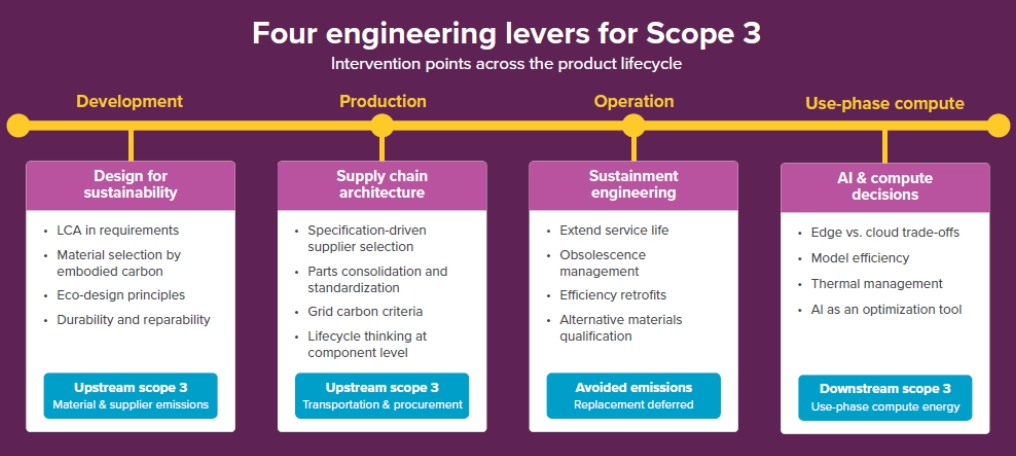
Product companies have more control over their Scope 3 trajectory than most sustainability programs recognize. The following engineering capabilities directly influence value chain emissions, even though they rarely appear in sustainability frameworks.
Sustainability is a design constraint, not a reporting metric
Life cycle assessment has existed as a methodology for decades, but it has typically been applied retrospectively, as a way to measure the environmental impact of products already designed and in production. The shift required is to integrate LCA into the design process itself, making environmental impact a design constraint alongside cost, weight, performance, and reliability.
This means embedding sustainability requirements into engineering specifications from the earliest stages of development.
- Material selection guided by embodied carbon data alongside mechanical properties
- Supplier qualification criteria that include grid carbon intensity and manufacturing efficiency
- Architecture decisions that consider not only initial production but maintenance burden and end-of-life material recovery as well
Several regulatory frameworks are pushing in this direction. The EU Ecodesign Regulation is expanding beyond energy-related products to cover a broader range of goods, with requirements for durability, reparability, and recyclability that must be addressed in design. Digital product passports will require tracking of materials and components throughout the product lifecycle. These are not reporting requirements that can be satisfied after the fact. They are design requirements that must be satisfied during development.
The engineering capability required is not exotic either. It involves integrating environmental data sources into existing design tools, establishing sustainability targets in requirements documents, and including environmental impact in design reviews alongside traditional performance metrics. The challenge is organizational: ensuring that sustainability criteria carry weight in trade-off decisions where they compete with cost or schedule pressures.
Keeping assets in service avoids the carbon cost of replacement
The traditional framing of sustainment engineering focuses on return on investment. The goal is to extend asset service life, defer replacement expenditures, and maintain revenue from spares and service. This framing is accurate but incomplete. Every year an aircraft, locomotive, or industrial system remains in productive service is a year the embodied carbon of its replacement is avoided.
For long-lived capital assets in aerospace, rail, energy, and heavy industry, embodied carbon often dominates the lifecycle footprint. Manufacturing an aircraft generates substantial emissions from material production, component fabrication, and assembly. Operating that aircraft for another decade, with appropriate upgrades and maintenance, typically generates less total lifecycle emissions than retiring it early and building a replacement, even if the new aircraft is more fuel-efficient per flight hour.
However, it is crucial to note that this calculation is context-dependent. The sustainability case for extended service life depends on the ratio of embodied to operational emissions, the efficiency gap between old and new designs, and the specific upgrade path available. For some products, accelerated replacement genuinely reduces lifecycle emissions. For many capital-intensive assets, the opposite is true.
The engineering work that enables extended service life, manages component obsolescence, qualifies alternative materials, implements retrofitting efficiency improvements, and maintains regulatory compliance through design changes has always contributed to sustainability outcomes. What has changed is the need to quantify that contribution and integrate it explicitly into the sustainability strategy. Sustainment engineering teams hold significant Scope 3 reduction potential that most corporate sustainability programs do not recognize or measure.
Scope 3 emissions are locked in at the spec, not at procurement
In most enterprises, procurement teams negotiate with suppliers, while engineering teams determine what to procure. The distinction matters for sustainability because engineering specifications constrain procurement options before any negotiation begins. A component specified to require a particular alloy, a specific manufacturing process, or a certain tolerance effectively selects which suppliers can participate. The Scope 3 footprint is embedded in the specification.
Parts consolidation and standardization can improve sustainability outcomes, but the relationship is not automatic. Reducing unique part numbers simplifies logistics, concentrates purchasing power, and can enable economies of scale in sustainable manufacturing. Standardized components are easier to recover and recycle at the end of life because material streams are more uniform.
The counterargument is that standardization can lock in suboptimal designs. A component standardized before sustainability was a priority will perpetuate its material and energy profile across an entire product portfolio. Sometimes the sustainable choice is the specialized choice. E.g., a lightweight composite optimized for a specific application may have a lower lifecycle impact than a standardized steel part, even though the composite complicates the supply chain.
The engineering judgment lies in knowing when standardization helps and when application-specific optimization is the better path. This requires lifecycle thinking at the component level, understanding beyond the first cost and evaluating material intensity, use-phase implications, and end-of-life recovery potential. Supply chain sustainability is not primarily a procurement problem. It may actually be an engineering architecture problem that procurement inherits.
AI architecture decisions have lasting energy consequences
Artificial intelligence (AI) is transforming product capabilities across industries, but AI implementation carries substantial energy implications that vary dramatically based on engineering choices. Whether to run inference at the edge or round-trip to cloud data centers, which model architectures to deploy, and how to manage thermal loads from AI processors are all engineering decisions with direct sustainability consequences.
Edge computing keeps inference local, reducing data transmission energy and avoiding dependence on data center capacity. Cloud computing centralizes compute resources, enabling more sophisticated models but creating demand for infrastructure that drives emissions in the technology supply chain. The right choice depends on latency requirements, model complexity, power budgets, and connectivity constraints. It is an engineering trade-off that has sustainability implications.
Model efficiency is another significant engineering lever. Not all AI architectures require equal compute resources for equivalent performance. Techniques like quantization, pruning, and knowledge distillation can reduce model size and inference energy by an order of magnitude or more. Engineering teams that select or develop AI capabilities have significant influence over the operational energy footprint of those capabilities across the product’s service life.
AI is both a looming sustainability challenge and a sustainability accelerator. Machine learning applied to design optimization can identify material-efficient structures. Predictive maintenance powered by AI can extend component service life. Simulation enhanced by AI can reduce physical prototype requirements, avoiding the embodied carbon of test articles and the operational emissions of physical testing campaigns. The engineering task is to deploy AI thoughtfully, capturing its benefits for sustainability while managing its energy demands.
Scope 3 is an engineering problem, and the strategy should reflect that
The Science Based Targets initiative is revising its Corporate Net-Zero Standard, with Version 2 expected to be finalized in 20265. The revision will strengthen requirements for Scope 3 target-setting and progress measurement. Regulatory frameworks, including CSRD in Europe and climate disclosure rules in California, are expanding Scope 3 reporting obligations. The infrastructure for tracking value chain emissions will continue to evolve.
None of this infrastructure will reduce emissions on its own. Measurement, targets, and reporting create visibility and accountability, but they do not change the decisions that generate emissions in the first place. For product companies, those decisions live in engineering.
The organizational implication is that sustainability strategy requires direct engagement with engineering leadership, not just periodic data requests. The most effective organizations I see are the ones where CSOs and CTOs share objectives, and where sustainability targets translate into engineering requirements that carry real weight against cost and schedule pressures. For product companies and the engineering organizations that support them, sustainability work and engineering work are converging. The distinction between a design review and an environmental review is becoming artificial. The skills that reduce Scope 3 (life cycle thinking, material optimization, systems architecture) are engineering skills applied with a different objective in mind. That convergence will accelerate as regulatory pressure increases. Every year a sustainability team produces a Scope 3 report without influence over the engineering decisions behind those numbers is a year of measuring a problem it cannot solve.
Footnotes
- Microsoft 2024 Environmental Sustainability Report, covering fiscal year 2023. Microsoft reported total Scope 1, 2, and 3 emissions increased 29.1% from the 2020 baseline. Scope 1 and 2 emissions decreased 6.3% over the same period. https://blogs.microsoft.com/on-the-issues/2024/05/15/microsoft-environmental-sustainability-report-2024/
- McKinsey & Company, “What are Scope 1, 2, and 3 emissions?” September 2024. https://www.mckinsey.com/featured-insights/mckinsey-explainers/what-are-scope-1-2-and-3-emissions
- Huang et al., “Categorization of Scope 3 Emissions for Streamlined Enterprise Carbon Footprinting,” Environmental Science & Technology. https://pubs.acs.org/doi/10.1021/es901643a
- World Economic Forum, “The ‘No-Excuse’ Opportunities to Tackle Scope 3 Emissions in Manufacturing and Value Chains,” January 2023. https://www3.weforum.org/docs/WEF_No-Excuse%E2%80%9D_Opportunities_to_Tackle_Scope_3_Emissions_in_Manufacturing_and_Value_Chains_2023.pdf
- Science Based Targets initiative, Corporate Net-Zero Standard V2 consultation process. First draft released March 2025, second consultation draft November 2025, final standard expected 2026. https://sciencebasedtargets.org/developing-the-net-zero-standard
Quest Global is a global engineering services company delivering end-to-end product development and lifecycle solutions across aerospace, automotive, energy, rail, and industrial sectors. For more information, contact [email protected].