


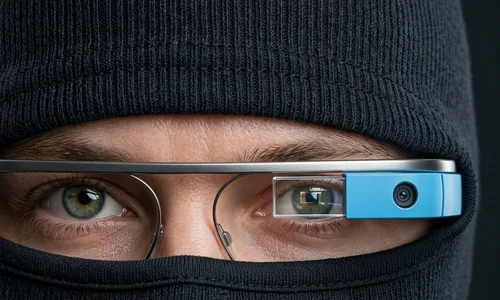
Halloween 2013, and Google Glass was the perfect accessory to complete my Cyborg costume. The explorer edition sat on your face like a lens-free, frame-less recording device with a heads-up display that everyone around you could see. I was the early-adopter neighbor, half man half robot, celebrating the ability to snap photos and record video with a voice command while cheerfully invading the privacy of everyone at the party.
The glasses could do remarkable things. They displayed directions in my peripheral vision, answered spoken questions, and doubled as a camera I never had to reach for. Short on style but loaded with features, Google Glass was roughly a decade ahead of a culture that had not yet normalized always-on recording. The selfie generation would eventually make front-facing cameras unremarkable, but in 2013, wearing a visible computer on your face made you a target.
Wearing one marked you as someone who prioritized technical novelty over reading the room. Restaurants started banning the devices. Colleagues would double-take when you walked in wearing one. Consumer advocacy groups pushed back hard, and the backlash effectively shelved smart glasses innovation for the rest of the decade. Google had built a working product and shipped it into a world that wanted nothing to do with the people who wore it.
At Digital River, we had been building payment and e-commerce applications for Glass, testing geo-targeted local advertising and services on the platform. The technical promise was real, and the commercial use cases were sound. But consumers did not come. For years afterward, the received wisdom in consumer electronics was that people simply are not ready to wear computers on their faces.
That turned out to be wrong, but it took the right partnership to prove it.
The Bet That Built A Category
Fast forward to 2020. Facebook, a year from renaming itself Meta, announces a smart glasses development partnership with EssilorLuxottica under the Ray-Ban brand, and the response is predictable skepticism. The company had acquired Oculus in 2014 but had never built successful consumer hardware on its own, and its portal video screens, launched two years earlier into a privacy backlash, had done little to change that record. EssilorLuxottica made eyewear, full stop. The whole arrangement looked like an expensive science project heading toward the same fate as Glass.
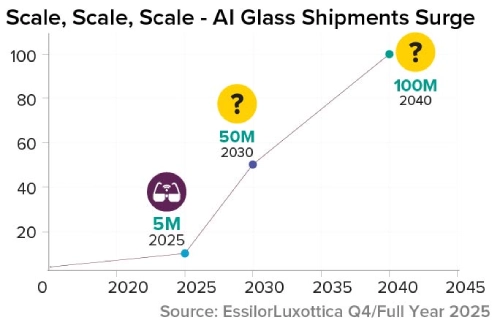
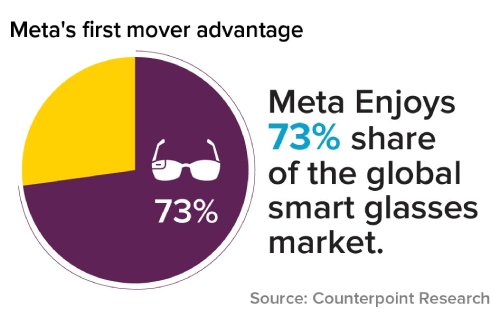
Five years later, AI glasses have sold more than 7 million units, with sales tripling year-over-year1.Meta holds 73% of the global smart glasses market2. EssilorLuxottica credits smart glasses for more than a third of its revenue growth in late 2025, and the company is pulling forward its timeline to reach 10 million units of annual production capacity.
What Tech Could Not Do Alone
EssilorLuxottica brought something to this partnership that Meta could not have built on its own, regardless of how much it spent. The company owns Ray-Ban, Oakley, Oliver Peoples, and Persol, holds exclusive licenses with Prada and Armani, and operates over 18,000 retail stores worldwide. When Meta needed to sell smart glasses, they ended up in eyewear shops staffed by people who actually know how to fit frames and handle prescription orders, rather than in electronics retailers where nobody could help with lens selection.
Glasses occupy a category where purchase decisions run on entirely different logic than consumer electronics. Nobody comparison-shops frames the way they compare smartphone processors. How heavy is it? Does it look good on my face? Can I get my prescription? These questions determine whether someone wears a device for years or abandons it after a week.
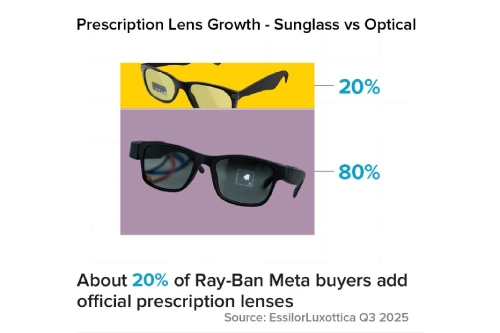
About 20 percent of Ray-Ban Meta buyers add official prescription lenses 3, and that number tells you what kind of product this has become. These are not gadget enthusiasts who will move on when the next thing ships. They wear a computer on their face every waking hour because they needed glasses anyway.
I have seen this dynamic play out in other contexts. During my time working with Meta Quest headsets for medical device pre-sales, the single biggest predictor of whether a clinical team would actually adopt VR demonstrations was comfort during extended wear. The teams that found the headset tolerable kept using it. Everyone else went back to printed brochures within a month. Wearable technology that feels like a burden will always lose to the path of least resistance, no matter how impressive the underlying capability. What EssilorLuxottica understood, and what Google missed in 2013, is that comfort and style are not finishing touches you add after the engineering is done. They are the engineering.
When AI Changed the Equation
The first-generation Ray-Ban Stories, launched in 2021, could capture photos and play audio. Sales were decent, but the product did not change how people actually behaved throughout the day. Users would wear them for a while, then go back to reaching for their phones.
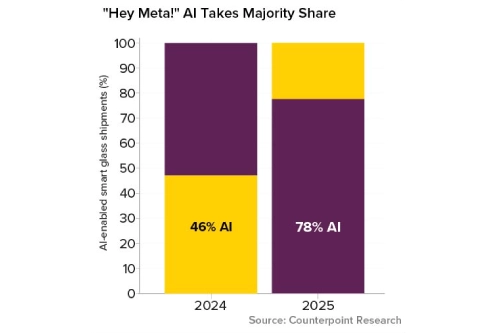
The second generation arrived in late 2023 with Meta AI built in, and usage patterns shifted. Users could ask their glasses to identify what they were looking at, translate conversations in real time, and get answers without pulling out a phone. AI-enabled smart glasses jumped from 46% of shipments to 78% in a single year, with that segment growing by more than 250 percent8. Smart audio glasses without AI capabilities actually shrank over the same period.
Sergey Brin addressed this directly when explaining Google’s return to the category. Glass arrived before AI could deliver consistent, useful value across a full day of wear. People had no compelling reason to keep the device on once the novelty faded. The current generation of AI assistants provides enough daily utility that wearing a computer on your face feels like a reasonable trade, especially when the glasses already look like something you would choose to wear anyway.
Google gives it another go
Google’s return to smart glasses shows how completely the Meta-Luxottica playbook has rewritten the industry’s assumptions about what it takes to compete. Instead of designing hardware internally and hoping the market catches up, Google committed $150 million to a partnership with Warby Parker, with products expected in 20264,5,6,7. They are also working with Samsung and the Korean eyewear brand Gentle Monster. The company that tried to go it alone with Glass is now building a coalition of fashion and retail partners before it ships a single frame.
The Public R&D Phase
Smart glasses have gone from a punchline to a product category in under a decade, and all of it is happening while the technology is still being figured out in the open. Millions of people are living with these devices on their faces daily, and every interaction generates data that shapes what gets improved, what gets cut, and where AI-specific features go next.
That kind of scale brings scrutiny, and rightly so. When Google Glass launched, the privacy concern was obvious because the device was conspicuous. The current generation looks like ordinary eyewear, which means the privacy conversation has evolved rather than disappeared. We saw a version of this play out with camera phones, where Japan’s mobile carriers and handset makers, responding to early voyeurism scandals, adopted shutter sounds that could not be muted. The industry set the norm before any law required it, the technology adapted, and the category continued to grow. Video conferencing platforms went through a similar cycle, evolving to give participants explicit control over when they are recorded. Smart glasses will follow a comparable trajectory. The intention behind this technology is to enhance how people experience their lives, heads up and present rather than hunched over a screen, and that intention will shape how the remaining concerns get resolved.
Writing the next chapter
EssilorLuxottica’s Chief Design Officer, Matteo Battiston, recently described the arrival of Google-Warby Parker and other new entrants into smart glasses as “a chapter yet unwritten”9. He welcomed the competition, arguing that more players will push the entire category forward and ultimately benefit consumers. He framed the future of wearables as depending on “invisible technology and visible humanity,” with designers at the center of making that happen.
I share that optimism, and I would go a step further. The chapter is not unwritten. It is being written right now, by the engineering teams figuring out how to scale validated architectures across dozens of frame styles, by the designers making sure technology disappears into something people actually want to wear, and by the consumers whose daily use is shaping the product in ways no lab could replicate. We are part of that process at Quest Global, and it is the most interesting engineering challenge I have worked on in my career.
Invisible engineering

Quest Global has been working in wearable technology for the better part of two decades, building remote service and support applications across industries from aerospace to healthcare. That industrial experience gave us a deep understanding of what it takes to put technology on a person and have it work reliably in unpredictable conditions. But the consumer wearable market operates at a completely different scale and level of complexity, and for the last five years, we have been on the front line of that shift.
We have co-developed validation and verification playbooks for wearable platforms, helped launch products at scale in cooperation with the largest technology companies in the world, and built reference architectures designed to stretch across dozens of brands and styles. What that scaling effort actually demands from an engineering standpoint, from thermal management to on-device AI to manufacturing at volume, is the subject of Part 2. Read more about how we get there at neprion.questglobal.com
Sources
- EssilorLuxottica Q4/Full Year 2025 Results: AI glasses (Ray-Ban Meta and Oakley Meta) sold over 7 million units in 2025, more than tripling year-over-year (EssilorLuxottica, February 2026)
- Counterpoint Research: Global Smart Glasses Shipments Soared 110% YoY in H1 2025, Meta 73% Market Share
- EssilorLuxottica Q3 2025: Smart glasses profitable, 20% prescription lens adoption, 10M capacity expansion (UploadVR)
- CNBC: Google commits $150M to develop AI glasses with Warby Parker (May 2025)
- CNBC: Google Says First AI Glasses With Gemini Will Arrive in 2026 (December 2025)
- Warby Parker Official Announcement: Intelligent Eyewear Partnership with Google
- BusinessWire: Warby Parker Partners with Google To Develop Intelligent Eyewear (May 2025)
- Counterpoint Research: Global Smart Glasses Market 2024 (210% YoY growth, 60% CAGR through 2029)
- Matteo Battiston, Chief Design Officer, EssilorLuxottica: LinkedIn post on smart glasses competition and design leadership (public post)