


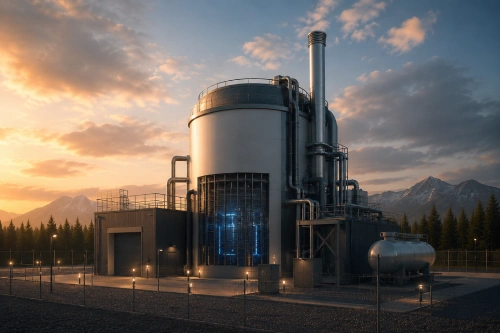
More than five billion dollars has flowed into small modular reactor developers since 2024, backed by technology companies chasing AI-driven electricity demand, venture capital firms betting on energy transitions, and federal programs accelerating clean baseload deployment. Google, Amazon, and Microsoft have each signed power purchase agreements with nuclear developers. The IAEA has recently revised its global nuclear capacity projections upward for five consecutive years, with its high-case scenario reaching 992 GW by 2050, up from 377 GW at the end of 2024. Established vendors are advancing light-water SMR concepts through licensing in multiple countries, while advanced reactor developers are pushing toward demonstration plants with DOE backing, and the U.S. military’s Project Pele microreactor has already received its first TRISO fuel delivery at Idaho National Laboratory.
The investment case is real, and the engineering is sound. And yet, the gap between the final detailed design approval and commercial deployment at scale remains enormous, because reactor design has never been the hard part. The hard part is building the manufacturing capacity, supply chain networks, and workforce pipelines that turn a certified and final design into dozens of deployed units at predictable cost with schedule certainty. That is the industrialization problem, and it is where the SMR industry will succeed or fail.
The predictability problem
When I talk to utility executives, infrastructure investors, private equity firms, and engineering leaders about SMRs, the conversation almost always comes back to predictability. Utilities need to go to their rate base and say with confidence what a project will cost and when it will deliver returns. Private equity firms that fund nuclear infrastructure are buying cash flow with known timelines and guaranteed returns for their shareholders. It isn’t necessarily the size of the investment, but rather knowing the investment is capped, and returns will be delivered with a date certain. Neither group is placing bets on technologies that cannot demonstrate cost and schedule discipline.
The last major completed U.S. nuclear construction effort offers a cautionary benchmark. Plant Vogtle’s two AP1000 reactors in Georgia were originally budgeted at $14 billion with startup dates in 2016 and 2017. The reactors entered commercial operation in 2023 and 2024, seven years behind the original seven-year schedule, at a total cost reported at approximately $35 billion across all project owners. The original reactor designer went bankrupt during construction, while the A/E constructor hemorrhaged cost and later also withdrew from the project. Twenty-four other proposed reactors across the country were shelved, and two partially built reactors in South Carolina were abandoned entirely.
The causes of the Vogtle overruns were not primarily about the science and technology around the nuclear steam supply system or NSSS (i.e., the reactor design). The NSSS was based on reactor physics that had been proven for decades in earlier versions of pressurized water reactor designs. The issue was all about completing the construction of the plant around the NSSS with all the supporting systems, structures, and components. Independent construction monitors documented problems with contractor management, site execution, rework on modules that were supposed to have been built offsite to save money, and a regulatory documentation backlog that alone added years to the schedule. The roots of these issues were established well before construction commenced by the fact that the balance of plant design was severely less complete than what was originally purported. These are execution problems, not technology problems. And they are precisely the kinds of problems that SMR developers will face as they move from first units to fleet-scale deployment.
The economics of serial production
The economic promise of SMRs rests on the premise of building the same design repeatedly, with costs coming down through continuous learning effects and manufacturing scale. And it goes without saying that once the first plant is completed, the full plant design is finalized, with the exception of design alterations for site-specific conditions. This is the “standard plant theory,” and it holds across industries from automotive to aerospace (think black Ford Model Ts). The trouble is that it only works when execution consistency is actually achieved, and nuclear construction has not demonstrated that consistency in decades. This past nuclear construction performance has been hampered by changing designs, variations in the supply chain, localization of craft, and the inability to incorporate lessons learned.
First-of-a-kind SMR projects are obviously expensive. The first unit at Ontario’s Darlington site, where construction began in May 2025 on what will be the Western world’s first grid-scale SMR, is forecast to cost approximately CAD $7.7 billion (USD $5.7B) for a single 300 MW unit. The three subsequent units on the same site are projected to cost significantly less per unit, reflecting not only the learning curve the developers are counting on but also taking credit for the engineering and procurement overheads that are not repeatable after the completion of the first unit. This will prove the theory of design once and build it many times. The total four-unit project is budgeted at CAD $20.9 billion (USD $15.5B). Whether those subsequent units actually achieve meaningful cost reductions will be the single most important data point for the global SMR industry over the next decade.
The NOAK, or nth-of-a-kind, cost targets that make SMRs competitive with gas turbines and renewables require capital costs to fall well below current FOAK estimates. Industry projections from as recently as 2020 estimated mature SMR costs at around $2,900 per kilowatt. Current FOAK realities are running several times higher. The IEA has estimated SMR overnight costs in the EU at approximately $10,000 per kW, and even optimistic projections suggest cost parity with conventional nuclear could take decades. Every cost overrun on early units undermines the credibility of serial production economics and chills investor appetite for the follow-on orders that make the learning curve possible.
What makes nuclear construction different from a typical industrial learning curve is the feedback cycle times and the fact that although the same construction firm may be executing the work, the actual craft worker performing hands-on work may not have that prior experience due to the localization of trades. This should not be the case where multiple units are being constructed in series at the same site (as in the SMR at the Darlington site in Ontario), with the benefit of a craft workforce that does not need to travel.
In automotive manufacturing, the learning curve time between units is measured in hours or days. In nuclear construction, the lessons from unit one take several years to materialize, and they must be incorporated while concurrent engineering, licensing, and construction are all still in motion. If construction reveals problems that require design changes, licensing amendments under 10 CFR 50.52, or conditions that force modifications, costs escalate quickly. Vogtle showed exactly this dynamic, and SMR developers need to demonstrate they have learned from it.
Design changes kill projects. These complex nuclear power plants are made up of many systems and subsystems. It is not possible to build a complete, fully optimized nuclear plant for constructability, maintainability, operability, and safety by trying to optimize each system individually. Many times, designers will change the design of a system to better optimize that individual system, only to see later that a daisy chain reaction was created to many other systems or components that were not entirely thought through, triggering catastrophic and cardinal changes to the design, which throws the cost and schedule into a whirlwind. This is where perfection is the enemy of good. Change should only be considered for personnel and nuclear safety.
Once the initial plant in a series is completed, any design changes to the subsequent units should be highly discouraged and avoided. Easy to say, but difficult to manage in a highly diversified engineering organization.
A broader demand picture: Beyond AI

Much of the current enthusiasm for SMRs is linked to AI-driven electricity demand, and that linkage carries risk. If AI infrastructure investment slows or efficiency gains reduce projected data center power requirements, the urgency behind civilian SMR deployment could soften. Outside of AI and data centers, U.S. electricity demand growth has been relatively flat for two decades; efficiency improvements have largely offset population growth, and the electrification of transportation has shown uneven momentum. With this said, some underlying dynamics of electrification of society in other areas and population growth in certain pockets of the country could have somewhat of an impact and have to be monitored and forecasted.
The demand case for nuclear power, however, extends well beyond civilian electricity. The U.S. military has operated nuclear reactors on submarines and carriers for more than sixty years and is now investing in next-generation microreactors for forward operating bases and critical infrastructure. Project Pele, led by the Department of Defense and built by BWXT, will be one of the first advanced microreactors to operate in the United States when testing begins at Idaho National Laboratory in 2027. Pele is a 1 to 5 MWe high-temperature gas-cooled reactor using high-assay low-enriched uranium (HALEU) that is transportable and modularized in a 20’ shipping container. The Army’s Janus Program is building on Pele to deliver resilient nuclear power at domestic military installations, with a mandate to have a reactor operating by late 2028. This demand is driven by energy security and operational independence, not electricity markets or carbon targets, and it does not evaporate if AI investment cools.
That diversification matters for the industrialization challenge. Military microreactor programs are building out TRISO fuel production, qualifying new suppliers, and exercising advanced manufacturing capabilities that directly benefit the civilian SMR supply chain. Even if civilian deployment timelines stretch, defense applications provide a floor of sustained demand that keeps the nuclear industrial base developing.
The largest advantage of a microreactor is the control of costs and schedules because they are very small, being manufactured in an off-site facility with the same supply chain, same means and methods, same workforce with proven repeatability. However, the downside is that they are very small in power output and likely at a disadvantage from the economies of scale when compared to a Nth of a kind GW-scale reactor. It does indeed fill a niche market for remote areas needing clean energy.
What comes next
As someone who began his career with an NSSS OEM and has spent over three decades in the power generation industry, I want to see it succeed. Nuclear power has been a quiet, reliable contributor of roughly 20% of U.S. electricity for decades. We figured out how to build these plants in the 1950s and 1960s, and I believe we can figure it out again. The challenges I have outlined here are solvable, but they do require focus, investment discipline, an inversion of the cash flow, which is necessary to invest heavily in design finalization prior to construction, and a willingness to plan for scale before the first order commitments arrive.
The leaders in the SMR race will be the organizations that solve the execution problems linked to supply chain capacity to produce nuclear-grade components at volume. They must also build and commission these plants with a qualified workforce, establish a project and contract management discipline to control cost and schedule, manage the intrusion of change into the follow-on designs, and develop regulatory throughput to license identical designs at multiple sites without treating each as a first-of-a-kind exercise.
In the second part of this series, I will dive into the supply chain and workforce barriers in detail, the attrition of nuclear-qualified manufacturers, the demographic cliff in nuclear power plant engineering, and what rebuilding the industrial capacity for serial SMR production actually requires. The technology is ready. Now the industry has to overcome these hurdles to build it at scale.
References
-
IAEA, “Energy, Electricity and Nuclear Power Estimates for the Period up to 2050,” 45th edition, September 2025.
https://www.iaea.org/newscenter/pressreleases/iaea-raises-nuclear-power-projections-for-fifth-consecutive-year -
Plant Vogtle cost and schedule data: E&E News / Politico, “After Vogtle, what’s next for nuclear?” May 2024.
https://www.eenews.net/articles/after-vogtle-whats-next-for-nuclear/ -
Darlington SMR project cost and timeline: GE Vernova Hitachi Nuclear Energy.
https://www.gevernova.com/nuclear/carbon-free-power/bwrx-300-small-modular-reactor/bwrx-300-darlington-ontario -
FOAK/NOAK cost analysis: GLOBSEC, “Faster, Cheaper, Smarter? The Promise and Pitfalls of Small Modular Reactors,” 2025.
https://www.globsec.org/what-we-do/commentaries/faster-cheaper-smarter-promise-and-pitfalls-small-modular-reactors -
Project Pele microreactor: U.S. Department of Energy, “Department of Defense Breaks Ground on Project Pele Microreactor.”
https://www.energy.gov/ne/articles/department-defense-breaks-ground-project-pele-microreactor -
TRISO fuel delivery milestone: Idaho National Laboratory, January 2026.
https://inl.gov/news-release/inl-advances-department-of-wars-project-pele-demonstration-microreactor-with-first-triso-fuel-delivery/ -
Army Janus Program and Executive Order 14299: POWER Magazine, December 2025.
https://www.powermag.com/a-first-for-military-nuclear-power-triso-fuel-arrives-at-project-pele/ -
IAEA workforce projection (4 million professionals by 2050): ANS Nuclear Newswire, “Four million nuclear jobs by 2050: Who will do them?”
https://www.ans.org/news/article-6224/four-million-nuclear-jobs-by-2050-who-will-do-them/ -
INL/NREL Advanced Reactor Cost Meta-Analysis, 2024.
https://atb.nlr.gov/electricity/2024/nuclear -
SMR FOAK cost data (Darlington): Carbon Commentary, “The first test for new Small Modular Reactors,” May 2025.
https://www.carboncommentary.com/blog/2025/5/11/the-first-test-for-new-small-modular-reactors-smr